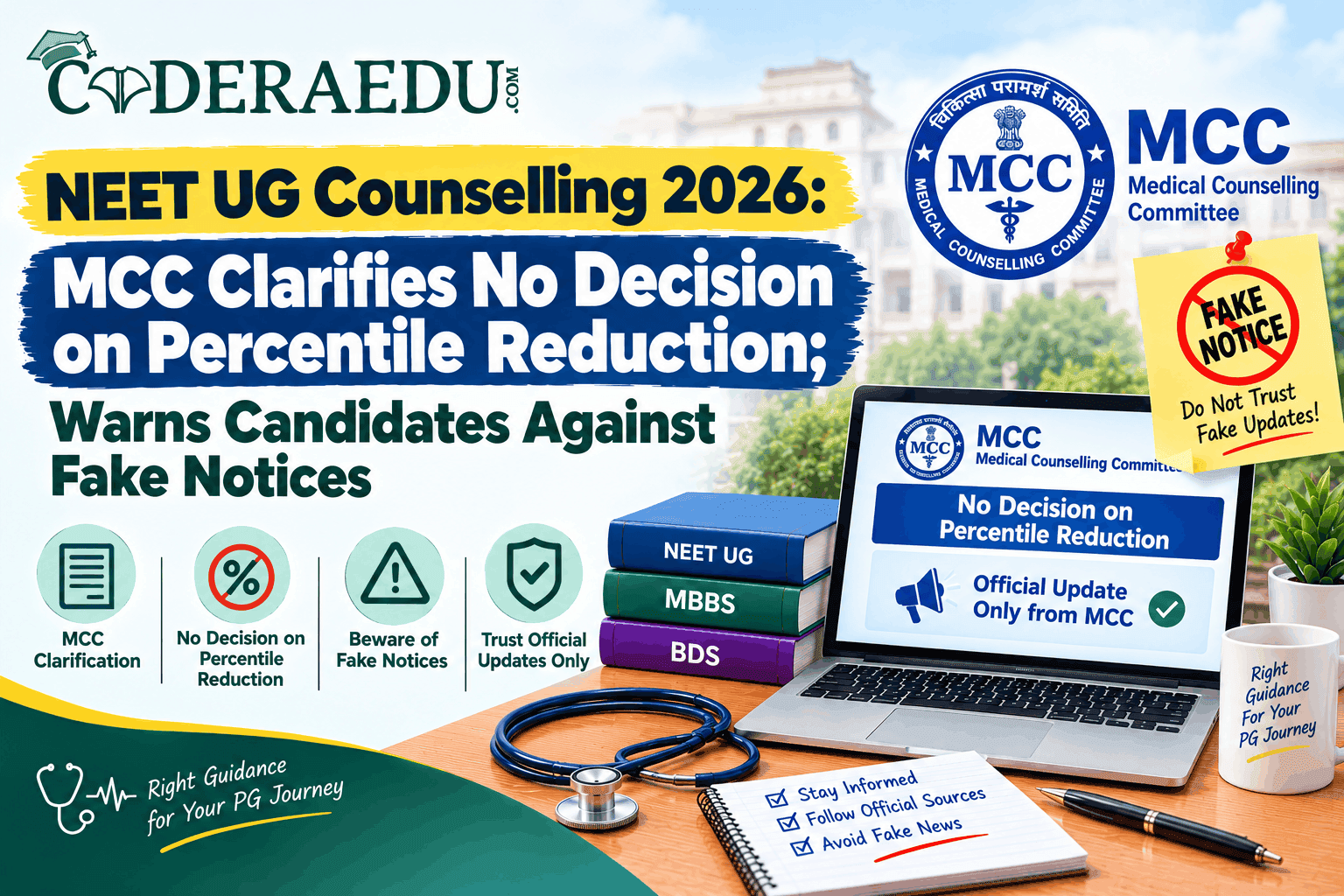
The Medical Counselling Committee (MCC) has clarified that no decision to reduce the qualifying percentile for NEET UG Counselling 2026 has been taken, and that a notice claiming otherwise is fake. The advisory, issued on October 13, 2026 under reference U-11011/07/2026-MEC, asks candidates to avoid fake websites and agents and to rely only on information hosted on the official MCC website.
The warning comes while the all-India stray vacancy round is under way, a period when candidates with lower scores often look for any sign of a relaxed eligibility rule.
PDF DocumentClick to download
What MCC Has Said
No such decision of percentile reduction has been taken by the competent authority— MCC advisory dated October 13, 2026
- MCC received information that a notice on percentile reduction in NEET UG Counselling 2026 was being circulated in the public domain.
- The notice is fake, and no such decision has been taken by the competent authority.
- MCC does not host any website other than its official site, and candidates should beware of fake websites and agents.
- Counselling information on the official MCC website should be treated as authentic.
- Any case of a fraudulent website or agent should be reported to MCC without delay.
What the Fake Notice Claimed
The fake notice was dated October 12, 2026 and was made to look like an MCC document. It said that the Ministry of Health and Family Welfare, in consultation with the National Medical Commission, had lowered the NEET UG 2026 percentile. It claimed that General and EWS candidates with 15 percentile and above, and SC, ST, OBC and PwD candidates with 10 percentile and above, would be eligible for counselling.
Actual NEET UG Qualifying Percentiles
| Category | Qualifying percentile |
|---|---|
| General / Unreserved and EWS | 50th |
| General / Unreserved PwD | 45th |
| SC, ST and OBC | 40th |
| SC, ST and OBC PwD | 40th |
Percentile relaxations do happen in some exams. For example, NBEMS lowered the qualifying percentile for NEET SS 2025 to the 30th after a Supreme Court order, and that kind of news can make a false claim look believable. Each relaxation, however, comes through an official notice from the exam or counselling authority.
Why Fake Notices Spread During Counselling
Fake notices tend to appear when seats are still vacant and candidates are anxious about eligibility. They are easy to make, because a logo, a letterhead and a reference number can be copied from a real document in a few minutes, and they spread quickly through messaging groups and coaching channels.
MCC has faced this problem before. In an earlier counselling cycle, it warned candidates against a fake allotment letter circulating on social media and said that seats are allotted only on merit and the choices candidates fill through its software. The same principle applies today: eligibility and allotment decisions come only from official channels.
How to Spot a Fake Counselling Notice
- Check the same notice on the official MCC website. If it is not there, treat it as unverified.
- Look at the reference number, date and source, and be wary of images or PDFs forwarded without a link.
- Do not trust agents who promise a seat, an allotment letter or an early result in return for money.
- Do not share the notice in groups before checking it.
- Report fake websites or agents to MCC, whose office email is listed on the notice as adgme@nic.in.
Related Resources
- Free NEET UG College Predictor 2026
- NEET UG Predictor: MBBS College Predictor by Rank
- JCECEB NEET UG 2026 State Merit List Correction Notice
- AIIMS New Delhi: Fees, Courses and Cutoff