CAT 2026 Syllabus: Section-Wise Topics, High-Weightage Chapters & Preparation Strategy

DeekshaUpdated on 07 Oct 2026, 08:00 AM IST
7 minutes read
Click to enlarge
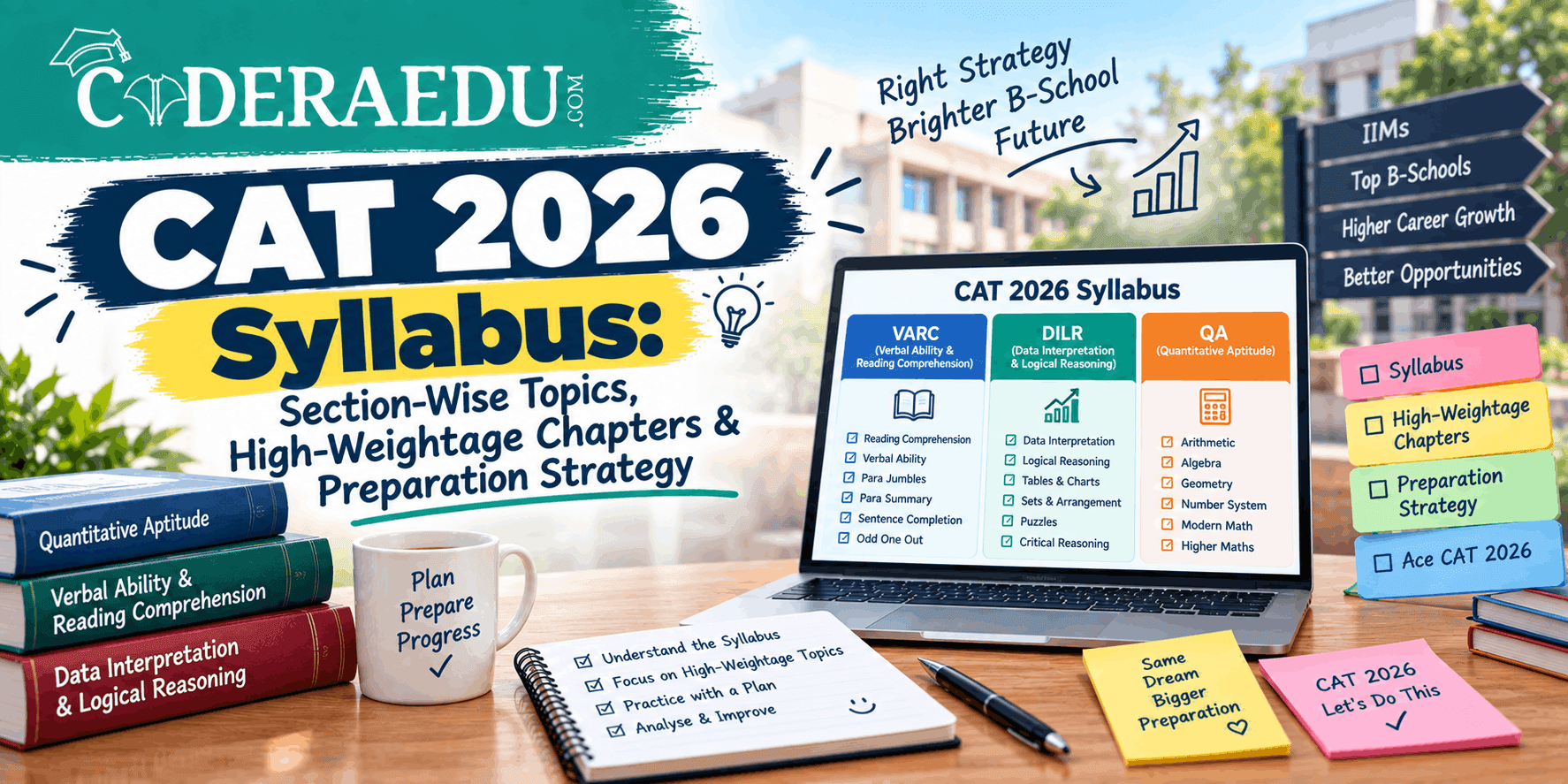
CAT 2026, conducted by IIM Indore on November 29, 2026, follows the same three-section format India's top B-schools have used since 2020: Verbal Ability and Reading Comprehension (VARC), Data Interpretation and Logical Reasoning (DILR), and Quantitative Aptitude (QA), with 68 questions across 120 minutes. The IIMs do not publish a formal 'syllabus' document; what candidates call the CAT syllabus is drawn from the consistent pattern of recent CAT papers.
This guide breaks the syllabus down section by section, flags the chapters that carry the most weight, and lays out a realistic preparation strategy for the weeks remaining before the exam.
CAT 2026 Exam Pattern at a Glance
Table
| Section | Questions | Marks | Time allotted |
|---|---|---|---|
| Verbal Ability & Reading Comprehension (VARC) | 24 | 72 | 40 minutes |
| Data Interpretation & Logical Reasoning (DILR) | 22 | 66 | 40 minutes |
| Quantitative Aptitude (QA) | 22 | 66 | 40 minutes |
| Total | 68 | 204 | 120 minutes |
4 columns · 5 rows
Sections must be attempted in a fixed order, VARC first, then DILR, then QA, and candidates cannot switch back to an earlier section once its 40-minute window closes. This section-locked format makes time management within each 40-minute block critical.
CAT 2026 VARC Syllabus: Topics and Weightage
Table
| Topic | Approx. share of VARC |
|---|---|
| Reading Comprehension (typically 4 passages) | Around two-thirds of VARC questions (roughly 16 of 24) |
| Para Jumbles | A recurring Verbal Ability question type |
| Para Summary | A recurring Verbal Ability question type |
| Odd Sentence Out | A recurring Verbal Ability question type |
| Para Completion | Occasionally featured alongside the above |
2 columns · 6 rows
Reading Comprehension passages typically cover varied themes such as economics, culture, science, philosophy and current affairs, testing inference, tone and main-idea identification rather than simple fact recall. Verbal Ability questions (para jumbles, summary, odd-one-out) are almost always non-MCQ (TITA) format, which carries no negative marking even if your answer is wrong.
CAT 2026 DILR Syllabus: Topics and Weightage
Table
| Topic | Typical format |
|---|---|
| Tables and Caselets | Data embedded in a written scenario or table requiring interpretation |
| Charts and Graphs | Bar graphs, line graphs, pie charts requiring data extraction and comparison |
| Arrangements | Seating, scheduling or sequencing puzzles based on given conditions |
| Games and Tournaments | Logical puzzles involving rules, rounds and outcomes |
| Scheduling and Logical Puzzles | Multi-condition reasoning sets requiring step-by-step deduction |
2 columns · 6 rows
DILR questions are typically presented as five sets, commonly two sets of 5 questions and three sets of 4 questions. Each set usually has a steep entry cost, meaning the first question or two in a set can take longer to crack, but subsequent questions in the same set often become much faster once the underlying structure is understood.
CAT 2026 QA Syllabus: Topics and Weightage
Table
| Topic area | Approx. share of QA |
|---|---|
| Arithmetic (percentages, profit & loss, time-speed-distance, time & work, ratios, averages, mixtures) | Largest single share; combined with Algebra, roughly 70% of QA |
| Algebra (linear and quadratic equations, inequalities, functions, logarithms) | Second-largest share, alongside Arithmetic |
| Number Systems | A consistent, moderate share every year |
| Geometry and Mensuration | A consistent, moderate share every year |
| Modern Mathematics (Permutations & Combinations, Probability, Sets, Progressions) | Smaller but recurring share |
2 columns · 6 rows
QA broadly follows a Class 8 to Class 10 mathematics foundation, tested at speed and often through word problems rather than direct formula application, which is why strong fundamentals matter more than memorising advanced formulas.
High-Weightage Chapters You Cannot Skip
- Reading Comprehension: makes up roughly two-thirds of VARC, so RC speed and accuracy alone can decide your VARC score.
- Arithmetic and Algebra together: make up around 70% of QA, making them the single highest-leverage topic area to master in the whole exam.
- Data Interpretation sets based on tables, caselets and charts: these appear every year and reward candidates who can quickly structure messy data into a usable form.
- Logical reasoning puzzles involving arrangements and conditions: a recurring DILR staple that rewards systematic, step-by-step elimination over guesswork.
- Para Jumbles and Para Summary: consistently tested, non-MCQ Verbal Ability questions with no negative marking, making them high-value, lower-risk attempts.
CAT 2026 Marking Scheme
Table
| Question type | Correct answer | Wrong answer | Unattempted |
|---|---|---|---|
| MCQ (Multiple Choice Question) | +3 marks | -1 mark | 0 marks |
| TITA / Non-MCQ (Type In The Answer) | +3 marks | 0 marks (no negative marking) | 0 marks |
4 columns · 3 rows
Because TITA questions carry no penalty for a wrong answer, they are generally worth attempting even on an educated guess, whereas MCQs should only be attempted when you can eliminate at least a couple of options confidently.
CAT 2026 Preparation Strategy: Section by Section
- VARC: Read widely and daily, across editorials, essays and varied non-fiction, to build reading speed and comprehension without losing accuracy. Practice para jumbles and summaries as a distinct daily drill, not an afterthought.
- DILR: Practice full sets under a strict time limit rather than isolated questions, since real CAT performance depends on quickly judging which of the five sets to attempt first. Build a habit of organising messy data into tables before attempting calculations.
- QA: Revisit Class 8-10 fundamentals in Arithmetic and Algebra until calculations become fast and near-automatic, since this pays off across roughly 70% of the section. Keep a running formula and shortcut sheet for Geometry, Number Systems and Modern Mathematics.
- Across all sections: prioritise full-length mock tests over isolated topic practice in the final weeks, since CAT rewards test-taking strategy and section-wise time allocation as much as raw subject knowledge.
Week-by-Week Preparation Plan Before CAT 2026
With roughly eight weeks remaining before the November 29, 2026 exam, this is a practical sprint structure rather than a slow, foundation-building plan. Adjust the pacing based on how much groundwork you have already covered.
Table
| Weeks before exam | Focus |
|---|---|
| Weeks 8-6 | Finish revising core concepts across Arithmetic, Algebra and Number Systems; build a daily RC and para-jumble habit; attempt your first couple of full-length mocks to establish a baseline. |
| Weeks 5-3 | Shift to topic-wise and set-wise timed practice in DILR; analyse every mock test in detail, not just the score, to identify which question types cost you the most time. |
| Weeks 2-1 | Take full-length mocks every few days under real exam conditions; focus on section-wise time allocation and selective attempt strategy rather than learning new topics. |
| Final week | Taper practice volume, review your mistake log and formula sheet, and focus on rest, exam-day logistics and mental readiness rather than cramming new material. |
2 columns · 5 rows
Common Mistakes to Avoid
- Spending too long on the first question of a DILR set instead of scanning all five sets first to judge which ones are actually solvable in the time available.
- Attempting every MCQ in QA regardless of confidence level, which can rack up negative marks faster than it adds positive ones.
- Ignoring TITA-format Verbal Ability questions out of unfamiliarity, when they carry no negative marking and are often easier to crack with practice than RC passages.
- Taking mocks without a structured review afterward, which wastes most of the learning value a mock test offers.
- Over-focusing on advanced or rare topics at the expense of Arithmetic and Algebra fundamentals, which carry the heaviest weightage in QA.
CAT does not reward knowing more topics than everyone else. It rewards knowing exactly which questions to skip, which is a skill built through mock analysis, not textbook study alone.
Related Resources
- MBA College Predictor
- CAT Predictor 2027
- CAT Exam Overview
- Top Management Colleges in India
- Top IIMs in India
- MBA College Directory
Useful Official Resources
Topics:
Share this article
Copy
Frequently Asked Questions
What is the CAT 2026 exam pattern?
CAT 2026 has three sections: VARC (24 questions, 72 marks), DILR (22 questions, 66 marks) and QA (22 questions, 66 marks), totalling 68 questions and 204 marks across 120 minutes, with a fixed 40-minute limit per section.
Does IIM Indore release an official CAT 2026 syllabus PDF?
No. The IIMs do not publish a formal syllabus document for CAT. The topics and weightage candidates refer to as the 'CAT syllabus' are inferred from the consistent pattern of recent CAT papers.
Which topics have the highest weightage in CAT 2026 QA?
Arithmetic and Algebra together typically make up around 70% of the Quantitative Aptitude section, making them the highest-leverage topics to prioritise, alongside a steady share from Number Systems and Geometry.
How much of VARC is Reading Comprehension?
Reading Comprehension typically accounts for roughly two-thirds of the VARC section, around 16 of its 24 questions, with the remainder made up of Verbal Ability questions like para jumbles, para summary and odd sentence out.
Is there negative marking in CAT 2026?
Yes, but only for MCQs: +3 marks for a correct answer and -1 mark for a wrong answer. Non-MCQ (TITA) questions carry +3 for a correct answer and no negative marking for an incorrect one.
Can I switch between CAT sections during the exam?
No. CAT sections must be attempted in a fixed order, VARC, then DILR, then QA, each within its own 40-minute window, and you cannot return to a previous section once its time is up.
What topics are covered in CAT 2026 DILR?
DILR typically includes tables, caselets, charts and graphs for data interpretation, along with arrangement puzzles, games and tournaments, and scheduling-based logical reasoning sets, usually presented across five sets of questions.
How should I prepare for CAT 2026 with only a few weeks left?
With limited time, prioritise full-length mock tests and detailed review over learning new topics, focus revision on Arithmetic and Algebra for QA and Reading Comprehension for VARC since they carry the most weightage, and practice DILR sets under strict timing to improve set-selection strategy.