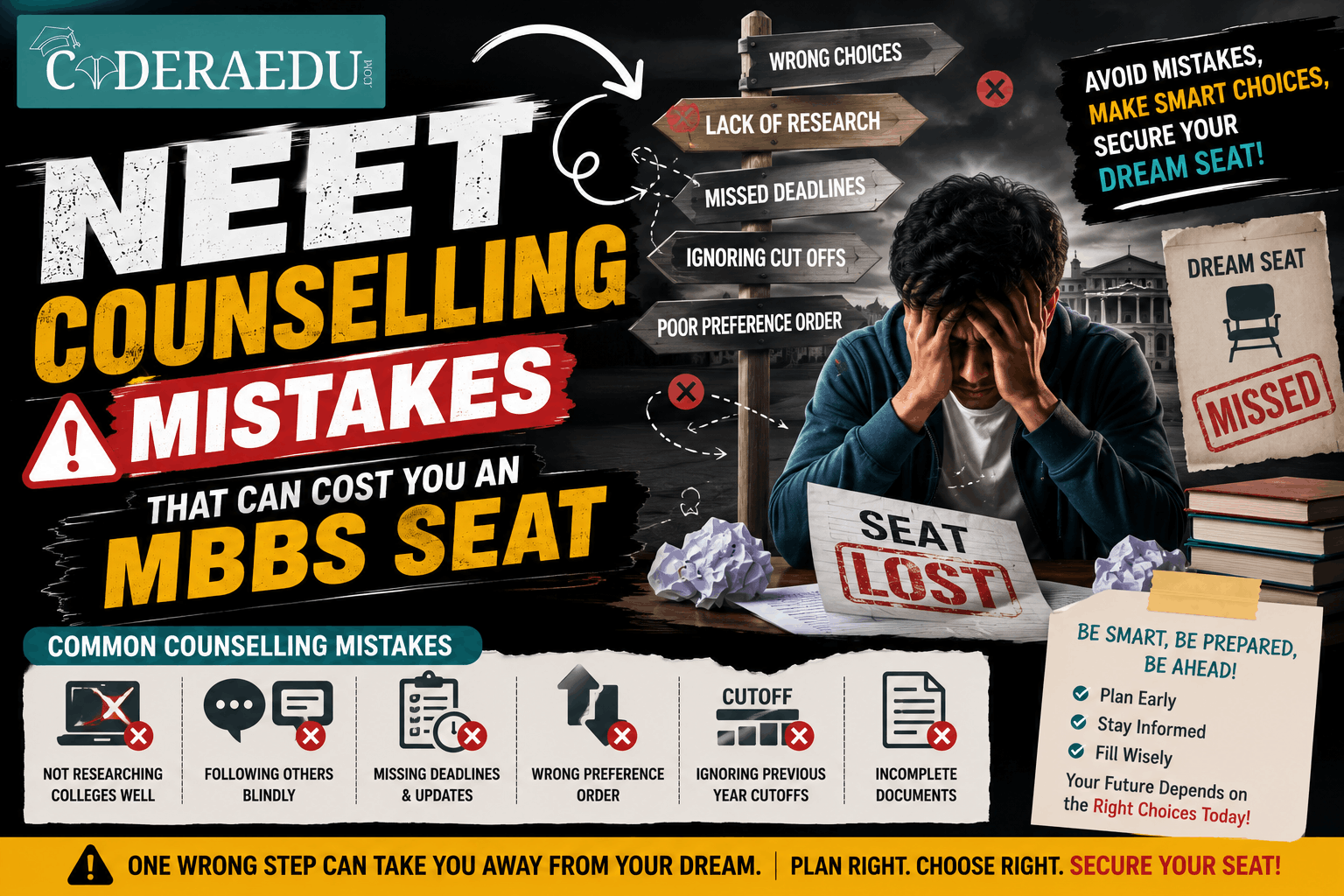
NEET Counselling Mistakes That Can Cost You an MBBS Seat

Click to enlarge
Every counselling season, a predictable set of avoidable mistakes causes candidates to lose an MBBS seat they were genuinely eligible for, not because their rank was insufficient but because of a missed deadline, a wrong document format, or a rushed choice list. This guide covers the mistakes that come up most often during NEET counselling 2026, why each one happens, and exactly how to avoid it. Start by checking your realistic options with the NEET UG College Predictor so the rest of your counselling decisions are based on accurate expectations rather than guesswork.
Mistake 1: Waiting for AIQ Results Before Registering for State Counselling
This is possibly the single most common and most costly mistake in NEET counselling. AIQ and state counselling run on independent timelines with independent deadlines. A candidate who waits to see their MCC Round 1 result before registering for their state's counselling process often finds the state registration window has already closed.
Register for both the moment their respective windows open, rather than waiting for one process to conclude before starting the other. Even if you expect your AIQ result to arrive first, treat state registration as a separate, equally urgent task on its own timeline, since neither authority coordinates its deadlines with the other. Registration windows and official notifications for AIQ counselling are published directly on mcc.nic.in, and it is worth checking this alongside your state's own portal the moment either one opens.
Mistake 2: Category Certificates in the Wrong Format
OBC, EWS and PwD certificates each have specific format and validity requirements that differ between AIQ and state counselling. A state-issued OBC certificate that does not follow the central government non-creamy layer format is routinely rejected by MCC for AIQ counselling, even if the same certificate is accepted at the state level.
- OBC certificates for AIQ must be in the central government format, specifying non-creamy layer status, and issued within the validity period set by MCC
- EWS certificates must be issued in the current financial year, older certificates are typically not accepted
- PwD certificates must come from a government hospital medical board, not a private clinic or individual doctor
- Domicile certificates for state quota must match the exact residency criteria defined by that specific state's counselling authority
A large part of this problem comes down to timing rather than eligibility. An OBC non-creamy layer certificate is typically valid for only one year from its date of issue, and candidates often apply for it right after Class 12 results, not realising that by the time counselling and document verification actually happen months later, the certificate has already expired. The certificate needs to remain valid through the verification date, not just the date you first apply for counselling.
Name and detail mismatches are another quiet cause of rejection. If your category certificate spells your name differently from your NEET application form, even a minor variation like a missing middle name or a different date of birth format, verification officers can flag it and ask for a corrected certificate on the spot, which is rarely possible to arrange during a short reporting window. Cross-check every field on your certificate against your NEET admit card and scorecard well before counselling begins, not during document verification itself.
Mistake 3: Arranging Choices by Fee or Familiarity Instead of Genuine Preference
Choice order is not a formality. The counselling software allots the highest ranked eligible choice on your list, without skipping ahead to a lower-ranked choice just because it seems statistically safer. Candidates who place a cheaper or more familiar college above one they actually prefer more, purely out of caution, sometimes end up allotted the less-preferred option simply because it appeared higher on the list.
Arrange choices purely by genuine preference, from the college you would accept without hesitation down to your last acceptable safe option. Checking a specific institution's admission page, such as Santosh Medical College and Hospital, Ghaziabad, for seat intake and previous closing trends before ranking it can help you judge where a borderline choice genuinely belongs. Let personal preference, not perceived safety, decide the final sequence within that realistic range.
Mistake 4: Filling Too Few Choices
Confidence in a good rank sometimes leads candidates to add only a handful of colleges, assuming their top few choices will certainly come through. When even one of those closing ranks shifts slightly higher than the previous year, and it happens more often than students expect, this leaves an empty Round 1 with no seat allotted at all.
There is also a psychological trap at play here. A candidate who fills only five or six choices tends to check the portal obsessively once results are due, mentally rehearsing which one they will get, and by the time it becomes clear none of them cleared, the confidence to quickly build a longer, well-researched list under pressure is gone. Building a wider list before results are declared, while you are calm and have time to actually compare colleges, almost always produces a better outcome than trying to expand a short list in a panic once Round 1 has already gone against you.
Table
| Common Assumption | What Actually Happens |
|---|---|
| "My rank is safely within last year's cutoff, I only need 5 choices" | Cutoffs shift year to year based on total candidates and paper difficulty, sometimes by thousands of ranks |
| "I will just add more choices in Round 2 if needed" | Round 2 seat availability is different and sometimes more limited at the specific colleges you wanted |
| "A short list is easier to manage" | An unallotted round wastes time and forces a rushed, less thoughtful list under more time pressure later |
2 columns · 4 rows
Mistake 5: Confusing Course Codes at the Same College
MBBS, BDS and BSc Nursing are listed as entirely separate choices even when offered at the same institution. In the process of quickly adding many colleges, it is easy to accidentally select the wrong course code, particularly at colleges offering multiple programmes under similar sounding names.
This mistake is especially easy to make on mobile, where dropdown menus for course selection are often condensed and harder to scroll through carefully compared to a desktop browser. A candidate scrolling quickly through a long list of colleges on a phone screen can tap the wrong course entry without noticing, since the college name is usually large and prominent while the course code sits in smaller text right next to it. Filling choices on a laptop or desktop, or at minimum zooming in and reviewing each entry before adding it, reduces this kind of accidental selection considerably.
- Double-check the course name next to each college entry before adding it, not just the college name
- Review your final list line by line before locking, cross-referencing against your original research notes
- If a college offers both MBBS and BDS and you are open to either, add both as separate, clearly ordered entries rather than assuming one selection covers both
Mistake 6: Paying Private College Fees Before Official Allotment
Some private colleges or their agents contact candidates directly, encouraging early fee payment to secure a seat before the official MCC or state Round 1 results are declared. Paying fees outside the official counselling process, before your name appears on an official allotment list, puts both your money and your official NEET seat at risk.
Do not make fee payments to any private college before your seat is confirmed through official MCC or state counselling allotment results.
Wait for official allotment confirmation on the MCC or state portal before any payment is made, and verify a college's official status through the MBBS college directory or its individual college page rather than relying solely on a phone call or agent.
Mistake 7: Not Reporting to the Allotted Institute Within the Window
Even candidates who choose to float or slide for a potential upgrade in the next round are typically still required to report to their currently allotted institute within a specified reporting window. Skipping this step, assuming it only matters for candidates who plan to freeze, is a common and costly misunderstanding.
Reporting requirements also differ between AIQ and state counselling in ways candidates rarely check in advance. Some state authorities accept online or documentary reporting for a seat, while MCC and several other states require physical presence at the institute with original documents within the window, and a few colleges additionally expect a provisional admission fee to be paid on the spot at reporting. Assuming the process will be identical to what a friend experienced in a different state or a previous round is a common way this deadline gets missed, so it is worth checking the exact reporting mode and requirements listed for your specific allotment rather than relying on general assumptions.
Missing the reporting deadline can result in the allotted seat being cancelled entirely, even if you intended to keep it as a backup while hoping for an upgrade. Always check the specific reporting requirement listed for your response type, freeze, float or slide, on the official portal for that round.
Mistake 8: Ignoring Category Rank in Favour of Overall Rank Only
Reserved category candidates sometimes build their entire choice filling strategy around their overall All India Rank, overlooking that reserved seat eligibility is determined by category rank instead. This mistake can lead to either underestimating genuine options, by assuming an unremarkable overall rank rules out strong colleges, or overestimating general category seat chances that the category rank alone does not support.
Check both numbers separately using your official scorecard, since category rank and overall rank are calculated independently and can differ by a wide margin for the same candidate. This gap matters most at colleges with a large reserved seat quota, such as Vidur Autonomous State Medical College, Bijnor, where checking category rank against actual closing trends gives a far more accurate picture than relying on overall rank alone before building your final choice list.
Mistake 9: Skipping Mop-Up and Stray Vacancy Rounds
Some candidates assume that if Round 1 and Round 2 did not result in a preferred seat, later rounds are not worth the effort. In reality, Mop-Up and Stray Vacancy rounds often see seats open up at reputed colleges as candidates from earlier rounds confirm admission elsewhere and withdraw from further rounds.
There is also a mindset shift worth making here. Candidates often treat Mop-Up and Stray Vacancy as a consolation option only to be considered if everything else has failed, which leads them to under-prepare for it compared to how carefully they approached Round 1. In practice, these later rounds sometimes have less predictable outcomes precisely because fewer candidates are actively competing and paying attention, which occasionally works in favour of someone who does show up prepared with an updated, well-researched list rather than treating it as an afterthought.
- Continue tracking counselling notifications even after an unsuccessful Round 1 or Round 2
- Widen your choice list for Mop-Up and Stray Vacancy rounds, since the remaining seat pool and closing ranks can shift meaningfully
- Do not assume a college that closed above your rank in Round 1 is unreachable in a later round
Mistake 10: Treating a Rank Predictor's Estimate as a Guaranteed Number
A rank predictor gives a probable range based on historical data and statistical modelling, not a confirmed final rank. Candidates who plan their entire choice list around the exact midpoint of a predicted range, without leaving margin for variation, sometimes find their actual rank falls outside that narrow assumption.
This matters most for candidates sitting right at a college's border closing rank, where the difference between an ambitious and a safe classification is often just a few hundred ranks. If you are also weighing AIIMS, deemed or AYUSH alternatives alongside your main MBBS list, cross-check closing rank trends for those options too rather than relying on a single number, and build a choice list wide enough to remain useful even if your actual rank lands toward the less favourable end of the plausible range.
Mistake 11: Not Verifying a College's Recognition and Accreditation Status
Particularly for private and deemed colleges, it is worth confirming NMC recognition and current accreditation status before ranking a college highly on your list. Individual college pages such as Government Medical College, Nashik or GMC Jagdalpur list current recognition status, seat intake and affiliation details, which is exactly the kind of information worth checking before you commit a high slot on your list to any single institution.
Mistake 12: Rushing the Final Review Before Locking Choices
Choice filling deadlines often fall late in the evening, and server load tends to peak in the final hours before closing, sometimes causing pages to load slowly or time out. Candidates who leave their final review for the last hour face both technical risk and a higher chance of overlooking an error under time pressure.
- Complete your research and initial list at least two to three days before the deadline
- Do a first full review of the ordered list at least a day before the deadline, checking course codes, quota tags and order
- Do a final confirmation check on the morning of the deadline, then lock well before the closing hour to avoid peak server load
Mistake 13: Overlooking State-Specific Local Level Counselling Rules
Some states run additional local or institutional level counselling rounds outside the main centralised state process, particularly for certain minority-status or private colleges. Candidates who assume the main state counselling process covers every seat in that state sometimes miss these separate rounds entirely, especially when the registration window for a local round opens with little advance notice.
Check whether your target state has any such separate process by reviewing the specific college's admission page, such as Grant Medical College, Mumbai, since individual college pages often note any additional local-level counselling requirements alongside the main state process. When in doubt, contact the specific college's admission office directly rather than assuming the centralised state portal covers every seat.
Mistake 14: Not Cross-Checking Predicted Rank Against Multiple Sources
Relying on a single rank estimate, whether from a coaching institute's answer key analysis or one predictor tool, can lead to a choice list built around an inaccurate number. Small variations in how different tools normalise scores across exam shifts can produce noticeably different predicted ranks for the same marks.
- Cross-check your predicted rank using at least two different sources, including a dedicated rank and college predictor tool
- Treat the resulting figures as a range rather than a single confirmed number
- Build your choice list wide enough to remain useful across that entire range, not just the most optimistic estimate
Rank predictors calculate estimates using historical closing rank data, expected candidate numbers and score distribution patterns, and small differences in these assumptions between tools can produce noticeably different results for the same score. This is exactly why relying on a single source is risky. Cross-check your estimate across at least two tools before treating any single predicted rank as final, then build a choice list wide enough to remain useful across that entire range rather than around one number.
Mistake 15: Ignoring the Difference Between Qualifying Cutoff and Admission Cutoff
Some candidates mistakenly believe that clearing the NEET qualifying cutoff, the minimum percentile set by NTA, is enough to guarantee a reasonable college. Qualifying cutoff only makes a candidate eligible to participate in counselling. The admission cutoff, meaning the marks actually required to secure a seat at a specific college, is typically far higher and varies significantly by college, category and quota.
This distinction plays out differently across institutions. A college such as Bhagwan Mahavir Institute of Medical Sciences, Pawapuri illustrates this well, since its admission cutoff for state quota candidates sits well above the bare qualifying threshold, and understanding this distinction early prevents unrealistic expectations going into choice filling.
A Quick Mistake-Prevention Checklist
- Registered for both AIQ and state counselling as soon as each window opened, without waiting for one result before starting the other
- Verified category, domicile and PwD certificate formats weeks in advance
- Ordered choices by genuine preference, not perceived safety or fee alone
- Added a wide enough list to cover ambitious, realistic and safe options
- Double-checked course codes and quota tags for every entry before locking
- Confirmed reporting requirements for whichever response, freeze, float or slide, was chosen after each round
- Avoided any private payment before official allotment confirmation
- Planned to participate in Mop-Up and Stray Vacancy rounds if earlier rounds did not work out
Most of these mistakes are entirely avoidable with a bit of advance preparation rather than any special expertise. Researching your options early, verifying documents well before deadlines, and giving yourself enough time at every stage, rather than compressing research, registration and choice filling into the final days of each window, covers most of what typically goes wrong during a rushed counselling season.
Topics:
Share this article
Copy
Frequently Asked Questions
What is the most common mistake in NEET counselling that costs a seat?
Waiting for AIQ results before registering for state counselling is one of the most common and costly mistakes, since state counselling deadlines often close before AIQ results are even declared.
Can I lose an already allotted seat by not reporting to the college?
Yes. Even if you choose to float or slide for a possible upgrade, most counselling authorities still require you to report to your currently allotted institute within a specified window, and missing this can lead to cancellation of the allotted seat.
Why do OBC certificates sometimes get rejected during AIQ counselling?
AIQ counselling requires OBC certificates in the central government format specifying non-creamy layer status. A state-issued OBC certificate that does not follow this exact format is typically rejected by MCC, even if it is valid for state counselling.
Is it safe to pay a private medical college directly before counselling results are out?
No. Paying fees to a private college before your seat is confirmed through official MCC or state allotment results is risky, since the seat is not officially yours until it appears on the official allotment list.
Does the order of my choice list actually affect which college I get?
Yes. The counselling system allots the highest ranked eligible choice on your list, so if a less preferred college is placed above a more preferred one, you may be allotted the one placed higher, not the one you actually wanted more.
Should I still participate in Mop-Up and Stray Vacancy rounds if earlier rounds did not work out?
Yes. Seats at reputed colleges often open up in Mop-Up and Stray Vacancy rounds as candidates from earlier rounds confirm seats elsewhere and withdraw, so skipping these rounds can mean missing genuine opportunities.
How can I avoid technical issues while locking my choices near the deadline?
Complete your research and ordering well before the deadline, do your final review a day in advance, and lock your list on the morning of the deadline rather than in the final hour when server load typically peaks.
Confused About College Admissions?
Get expert advice on college selection, admission chances, and career path in a personalized counselling session.
Book a Counselling Slot
Select Date
Pick a Slot